The Garuda Purana includes teachings about death, ancestral rites and liberation, but it is not solely a funeral text. Worship, sacred places, conduct and giving also appear in its wider contents. To understand a passage about Shraddha, begin with the edition and the part of the book being quoted.
Scriptures
What the Garuda Purana says about Shraddha
Why the text is associated with bereavement
The teachings are connected with Vishnu and Garuda. The funerary material describes the departed and the rites offered for them, which explains its place in some families' mourning customs. A family's custom of reading that material after a death does not establish that every section of the work is a funeral reading.
M. N. Dutt's 1908 edition also contains discussions of temples, conduct, gifts and yoga. Its breadth is easy to miss when the title is used only for teachings about death.
The Shraddha passages
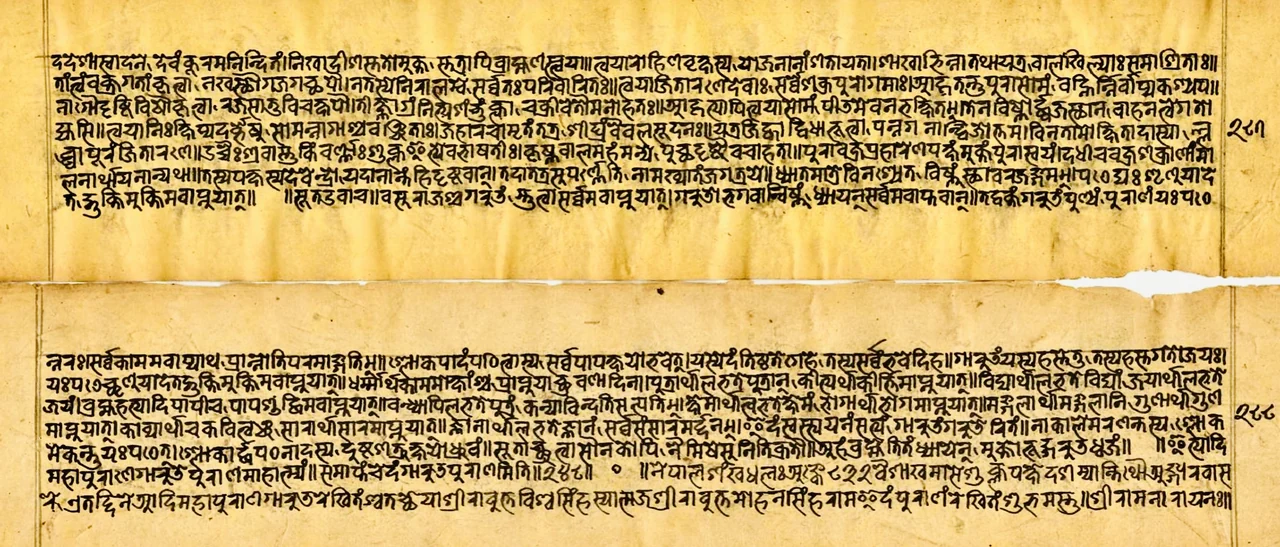
Chapter 99 of Dutt's edition discusses occasions for Shraddha, including the new moon and Pretapaksha. On printed pages 284 and 289 it refers to the ancestral fortnight and offerings during Bhadra's waning fortnight through its closing new moon. Water, sesame, food and paternal and maternal ancestors appear in this discussion.
These passages help explain why Shraddha includes different kinds of offering and why the family calendar matters. The text's religious account and the current year's civil dates answer different questions.
Gaya and giving
Chapters 82–86 describe ancestral offerings in Gaya, including the Falgu and Pretashila. Chapter 84 includes a deceased mother's separate Shraddha: the Gaya discussion is not restricted to fathers.
Chapter 98 treats gifts such as cows, food and water. It discusses recipients and giving according to means alongside care for people in need. Our Gau Daan article explains the cow gift and the distinction between a formal religious gift and support for cattle care.
Is the Saroddhara the complete Garuda Purana?
No. The sixteen-chapter Garuda Purana Saroddhara, translated into English by Ernest Wood and S. V. Subrahmanyam in 1911, is an abridged work. Its chapter numbers cannot be transferred directly to the larger Purana.
Dutt's edition needs its own qualification: his preface, pages iv–v, explains editorial exclusions and critically discusses the appended Pretakhanda. It should not be labelled a complete, unchanged text of every manuscript tradition. When comparing quotations, record the full title, translator, section and chapter.
Can it be read outside a mourning period?
Customs about the funerary chapters differ. The sources discussed here do not support declaring the entire book universally forbidden or unlucky at other times. Identify the part being read and the religious tradition giving the instruction.
Sources & further reading
- Garuda Purana — M. N. Dutt’s 1908 editionSee chs. 82–86, pp. 212–237; ch. 98, pp. 281–284; ch. 99, pp. 284–289. Dutt explains his editorial exclusions in preface pp. iv–v; this is an identified edition, not an unedited complete text of every recension.
- Garuda Purana Saroddhara — 1911 title pageEnglish translation by Ernest Wood and S. V. Subrahmanyam. The title identifies the Saroddhara; its numbering must not be confused with other Garuda Purana editions.
- Delhi University Library — Garuda Purana Saroddhara catalogueBibliographic confirmation of the 1911 title and translators; used for edition identification, not as ritual authority.
Read our editorial policy for sourcing and updates.
All articles and guides